An option is a contract that gives the buyer a right, but not an obligation, to buy or sell an underlying asset at a stated price on or before a stated date. The seller of the option takes on the obligation if the buyer exercises that right. In India, the underlying is usually an index such as the Nifty 50 or Bank Nifty, or a liquid stock.
That definition is simple. The behaviour is not. An option premium is made of two parts, one of which decays with time, and the position can lose money even when the underlying moves in the direction you expected. This guide builds the concept from the contract upward, so the arithmetic makes sense before any strategy does.
The four things in every option contract
- Underlying: the instrument the option is based on, such as the Nifty 50 index.
- Strike price: the level at which the right applies. A 25,000 call gives the buyer the right to buy the index at 25,000, in effect settling the difference.
- Expiry: the date on which the contract ends. Indian index options have weekly and monthly expiries, and the specific days are set by the exchange.
- Premium: the price the buyer pays the seller for the right. This is the most you can lose as a buyer, before costs.
A call option benefits from a rise in the underlying. A put option benefits from a fall. Buying a call is not the same as buying the stock: you pay a premium for a leveraged exposure that expires. Selling a call or put is a different activity altogether, with a different risk profile.
Premium is not price: intrinsic and extrinsic value
Every premium has two components. Intrinsic value is what the option would be worth if it expired right now. Extrinsic value, also called time value, is what the market pays for the possibility of a larger move before expiry.
| Component | What it represents | What makes it change |
|---|---|---|
| Intrinsic value | The difference between the underlying price and the strike, when favourable. | Moves with the underlying. It is zero when the option is out of the money. |
| Extrinsic value | The premium paid for time and uncertainty. | Falls as expiry approaches; rises when implied volatility rises. |
Suppose the Nifty is at 25,200 and you are looking at the 25,000 call. Its intrinsic value is 200 points. If the premium is 260, the extrinsic value is 60. If you buy it and the Nifty rises to 25,300 by expiry, the option settles at 300 intrinsic value, so your gross gain is 40 points on a 260-point premium. That is a 15% return on the premium, before costs, for a 0.4% move in the index. If the index rises more slowly, or falls back, the time value can disappear faster than the intrinsic value grows.
Time decay: why you can be right and still lose
Options are wasting assets for the buyer. Every day that passes, the extrinsic value has less time to be realised, so it tends to fall. The rate of decay is not linear: it accelerates in the final days before expiry. This is why buying a weekly option a few days before expiry is a very different proposition from buying a monthly option with weeks remaining.
An illustration, with made-up numbers: a call with 100 points of extrinsic value and 30 days to expiry might lose a few points on a quiet day. The same option with five days left might lose more than ten points on a quiet day, because there is less time for the move to happen. The exact decay depends on volatility and the distance from the strike, but the direction is reliable: the buyer pays for time, and time runs out.
This is the first hard lesson in options. Direction alone is not a strategy. You need the underlying to move enough, in the right direction, before the premium decays. A trader who expects a 1% rise over two weeks and buys a short-dated option may be correct about direction and still lose money.
The Greeks, in plain language
| Greek | What it describes | Why it matters |
|---|---|---|
| Delta | How much the premium changes for a one-point move in the underlying. | Tells you the effective exposure. A 0.5 delta option behaves like half a unit of the underlying for small moves. |
| Gamma | How quickly delta changes as the underlying moves. | High gamma near expiry means the position’s risk can change abruptly. |
| Theta | The change in premium from one day passing, all else equal. | The buyer pays it, the seller receives it. It is the cost of waiting. |
| Vega | Sensitivity to implied volatility. | A rise in implied volatility raises premiums; a fall lowers them, even if the underlying is unchanged. |
The Greeks do not forecast the market. They describe the risks a position carries. A long call and a call spread can express the same directional view with very different theta, vega and maximum loss. Comparing those differences is more useful than memorising a list of named strategies.
Implied volatility and events
Implied volatility (IV) is the market’s expectation of future movement, priced into the premium. Before a major event, such as a budget, an election result or a central bank decision, IV usually rises because the market expects a larger move. After the event, IV often falls sharply, even if the move was in the direction you expected. That fall can reduce the value of a long option and increase the value of a short option.
This is why buying options before a known event is not the free bet it appears to be. You are paying for the expected move, and the market has already priced it. If the actual move is smaller than implied, the premium can fall even when you were right about the direction. The same logic applies to earnings announcements for single-stock options.
Open interest: useful, often misread
Open interest is the number of contracts currently outstanding at a strike. Rising open interest means new positions are being created; falling open interest means positions are being closed. It does not tell you whether buyers or sellers are dominant, because every contract has one of each. A large open interest at a strike can act as a reference point for market participants, but it is not a prediction, and a “max pain” calculation is a description of option positioning, not a guarantee of where the index will settle.
The risk of selling options
Selling an option collects the premium upfront, which feels like income. It is not. The seller has an obligation, and the maximum loss on a naked call is theoretically unlimited; on a naked put it is substantial. The margin required is there because the exchange knows the position can move against the seller quickly. A strategy that sells options for a small, frequent premium can produce a long run of gains followed by one loss that erases them.
Defined-risk structures, such as spreads, cap the maximum loss but also cap the maximum gain and add costs. They are not automatically safer or better; they are a different trade-off. The important point for a beginner is that collecting premium is not the same as earning income, and any provider that presents it as a reliable monthly salary is hiding the tail risk.
Draw the payoff before you choose a strategy
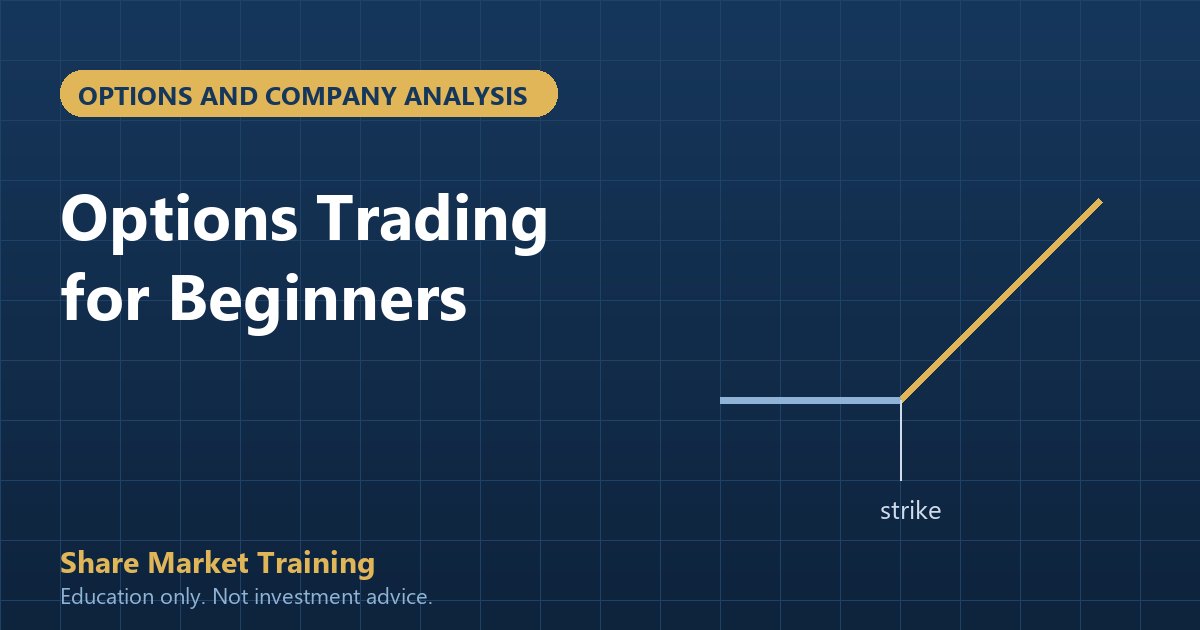
A payoff diagram is a simple graph of profit or loss at expiry against the underlying price. It forces you to see the maximum loss, the maximum gain and the range in which the position makes money. Before buying any option, sketch it. For a long call bought at a premium of 260 with a strike of 25,000, the loss is capped at 260 below the strike, and the position breaks even at 25,260. The diagram makes the trade-off visible: a limited loss in exchange for a move large enough to cover the premium.
Now sketch a bull call spread: buy the 25,000 call and sell the 25,300 call for a smaller net premium. The maximum loss is smaller, but the gain is capped at the difference between the strikes minus the net premium. The diagram shows immediately that the structure is cheaper and less ambitious. Neither is better in the abstract; they express different views and different risk budgets.
The exercise is worth doing for a short call and a short put as well. Seeing the unlimited or very large loss on the chart is more persuasive than reading a warning. It also makes clear why selling a naked option for a small premium is not comparable to buying one: the shapes of the outcomes are not symmetric.
The beginner mistakes
- Buying the cheapest option. A deep out-of-the-money option is cheap because the probability of a useful payoff is low. Cheapness is not value.
- Ignoring expiry. A weekly option bought on Thursday is a very short-dated bet, not a position you can hold and hope.
- Confusing premium with price. A ₹100 premium on a 25,000 index is not “a ₹100 stock”; the leverage and decay are entirely different.
- Adding to a losing option. Averaging down on a wasting asset increases the amount exposed to the same decay.
- Trading around events without understanding IV. The market has already priced the expected move.
- No maximum loss defined. Before the order, write the rupee amount you can lose. If you cannot, the position is too large.
- An option is a right with an expiry; the premium is the price of that right.
- Premium equals intrinsic value plus extrinsic value.
- Extrinsic value decays, and the decay accelerates near expiry.
- You can be right on direction and still lose on a long option.
- Implied volatility can fall after an event and hurt a long position.
- Selling options is not free income; it carries a large tail risk.
Options are worth learning properly because they are useful for hedging and for expressing views with defined risk. They are not a shortcut to income. The options trading course starts with payoff diagrams and the Greeks before any structure, and the futures and options course covers the wider derivatives segment. If you are new to charts, start with candlestick basics and the risk disclosure first.